
If you lodge a visa application while you are in Australia, you may be granted an Australian bridging visa. Bridging visas allow you to remain lawfully in Australia while the Department of Home Affairs processes your new visa application.
Although bridging visas are common, they are frequently misunderstood. Many visa holders are unsure:
- When their bridging visa becomes active
- Whether they can work
- Whether they can travel overseas
- What happens if their visa is refused
This comprehensive guide explains how Australian bridging visas work, the differences between BVA, BVB, BVC, BVD and BVE, and what you need to watch out for.
What Is an Australian Bridging Visa?
A bridging visa is a temporary visa granted to maintain lawful status in Australia during a transition period. Most commonly, this occurs when a person lodges an onshore substantive visa application and their current visa is due to expire before a decision is made.
A bridging visa:
- Is not permanent residence
- Does not guarantee visa approval
- Does not automatically provide work or travel rights
- Exists purely to maintain lawful stay
Bridging visas are a legal mechanism — not a discretionary benefit.
When Does a Bridging Visa Become Active?
This is one of the most misunderstood aspects of Australian bridging visas.
In many cases, a bridging visa is granted shortly after you lodge your new visa application. However, it typically only becomes active after your current substantive visa expires, if your application is still being processed.
For example:
- You hold a temporary visa valid until 30 June.
- You lodge a new onshore visa application in May.
- A Bridging Visa A is granted soon after lodgement.
- You remain on your original visa until 30 June.
- The bridging visa only becomes active on 1 July if your new visa has not yet been decided.
This activation timing is critical for work rights and travel planning.
Do All Onshore Visa Applications Result in a Bridging Visa?
Not necessarily.
Most valid onshore applications lodged while holding a substantive visa will result in a Bridging Visa A (BVA). However, exceptions include:
- Visas with a No Further Stay condition (e.g. 8503, 8534, 8535)
- Applications lodged after visa expiry
- Invalid applications
- Certain special visa subclasses
If the application is invalid, no bridging visa will be granted.
Types of Australian Bridging Visas
Below is a detailed comparison of the main bridging visas relevant to most migration clients.
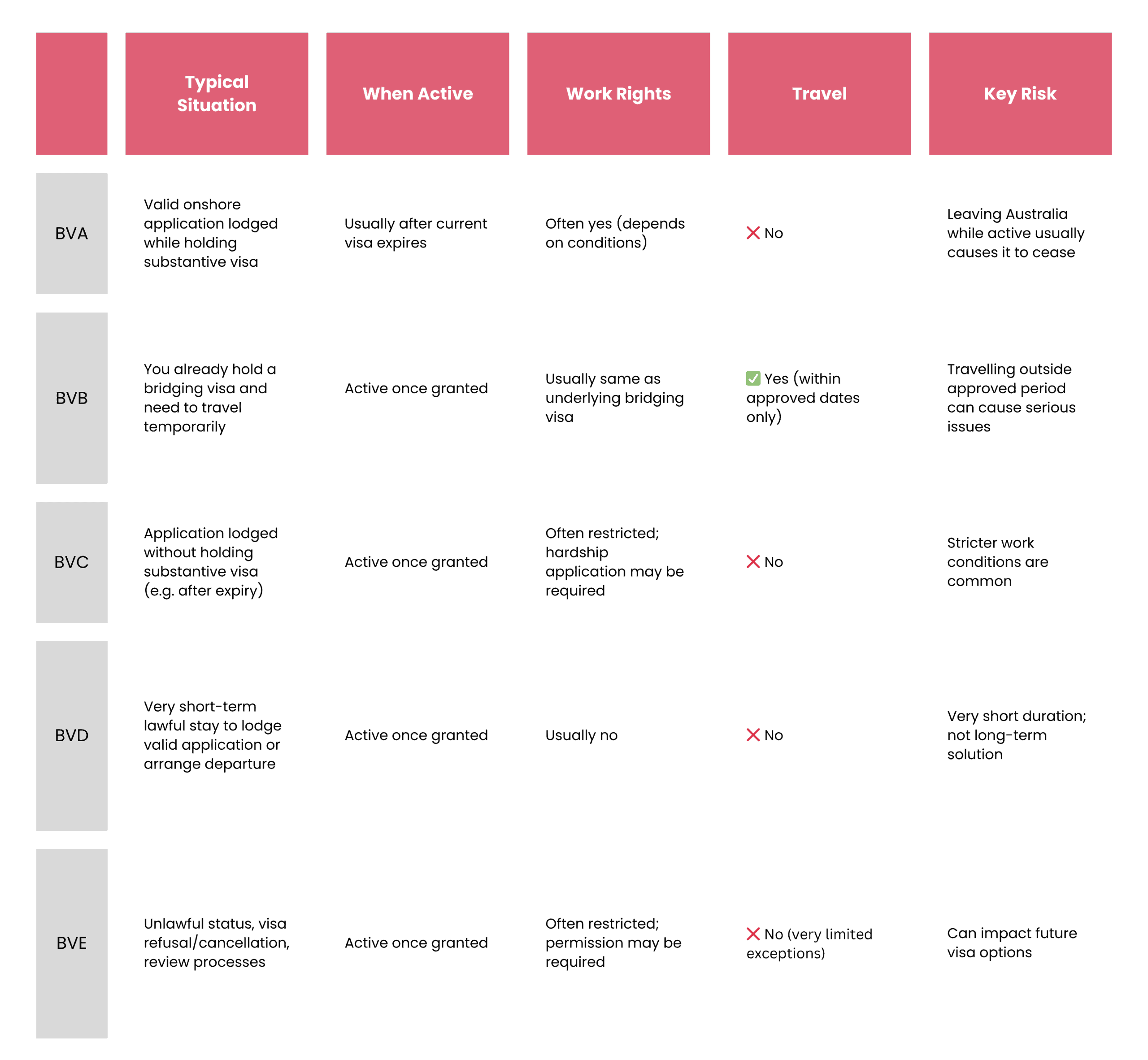
Bridging Visa A (BVA)
BVA is the most common bridging visa in Australia.
It is usually granted when a person lodges a valid onshore visa application while holding a substantive visa.
Key features:
- Keeps you lawful during processing
- Usually activates after your current visa expires
- Does not allow travel
- Work rights depend on conditions attached
If you depart Australia while a BVA is active, it generally ceases automatically.
Bridging Visa B (BVB)
BVB is required if you need to travel overseas while on a bridging visa.
It must be applied for separately and grants a limited travel facility for a specified period.
Important points:
- Travel dates are strictly limited
- Work rights usually remain the same as your current bridging visa
- Travelling outside the approved window can create serious problems
BVB is the only common bridging visa that permits travel.
Bridging Visa C (BVC)
BVC is granted when a person lodges an onshore visa application but is not holding a substantive visa at the time of application (for example, applying after visa expiry).
Key features:
- Allows lawful stay
- Does not permit travel
- Often includes a “no work” condition unless hardship is proven
BVC conditions are commonly stricter than BVA conditions.
Bridging Visa D (BVD)
Bridging Visa D is less common and designed for urgent, short-term situations.
It is granted to people who:
- Have become unlawful, or
- Are about to become unlawful, and
- Need a short period to lodge a valid application or arrange departure
BVD usually:
- Lasts only a few days
- Does not allow work
- Does not allow travel
It is not intended as a long-term bridging solution.
Bridging Visa E (BVE)
BVE is typically granted to individuals who are unlawful or resolving immigration issues, including after visa refusal or cancellation.
Key features:
- Allows lawful stay during certain processes
- Often includes restricted work rights
- Generally does not allow travel
- May affect future visa options
Because BVE situations can have serious long-term consequences, professional advice is strongly recommended.
Less Common Bridging Visas: BVF and BVR
Two additional bridging visas exist but are rarely encountered in standard migration pathways.
Bridging Visa F (BVF) is generally linked to specialised circumstances involving investigations or protective situations.
Bridging Visa R (BVR) is typically granted to individuals cooperating with law enforcement in serious matters.
For most skilled, partner, employer-sponsored and student visa applicants, the relevant visas are BVA, BVB, BVC, BVD and BVE.
Work Rights on Australian Bridging Visas
Work rights vary significantly depending on:
- The type of bridging visa
- Conditions attached
- Previous visa history
- Financial hardship applications
Always check:
- Your visa grant notice
- Your VEVO record
Never assume work is permitted without confirmation.
Travel Rules for Bridging Visas
Travel is one of the most common areas of risk.
In general:
- BVA → No travel
- BVC → No travel
- BVD → No travel
- BVE → No travel (with rare exceptions)
- BVB → Travel allowed only during approved period
Leaving Australia without proper travel permission can cause your bridging visa to cease and may disrupt your visa application.
When Does a Bridging Visa End?
A bridging visa typically ends when:
- Your new substantive visa is granted
- Your application is refused and review rights expire
- You depart Australia (in many cases)
- It is cancelled or replaced
Need Professional Advice on Your Bridging Visa?
Australian bridging visas are a crucial part of the migration system. However, incorrect assumptions about activation, work rights or travel can create serious consequences.
If you are unsure about:
- Which bridging visa you hold
- When it becomes active
- Whether you can work
- Whether you can travel
Southern Stone Migration can provide tailored advice to ensure you remain compliant and strategically positioned for your visa outcome.

