
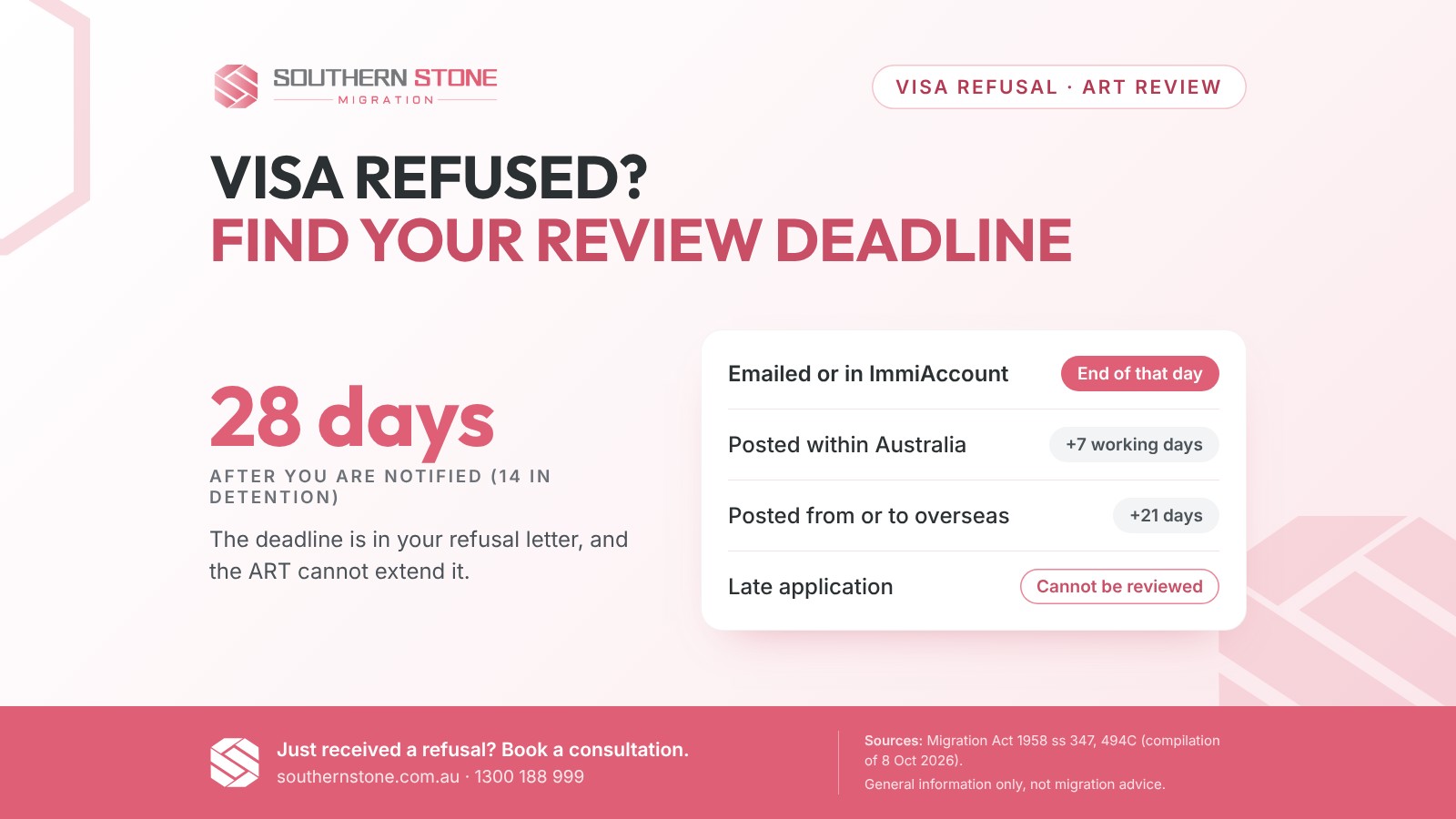
If your visa has been refused, the deadline to ask the Administrative Review Tribunal (ART) for a review is stated in the refusal letter itself, in the part that explains your review rights. As at 19 November 2026, for refusals that can be reviewed the time limit is 28 days after the day you are notified of the decision (14 days if you are in immigration detention), and the ART cannot extend it. The clock starts when the law treats the letter as received, which can be before you read it.
For what a review involves, see our visa refusal review (ART) page. Employers whose sponsorship or nomination was refused can also read about sponsorship and nomination refusal reviews.
Where in the refusal letter is the review deadline?
The law tells the Department what a refusal letter must contain. Under section 66 of the Migration Act 1958, if you have a right to review, the letter must state:
- that the decision can be reviewed
- the time in which the review application may be made
- who can apply for the review
- where the application can be made.
So look for the part of the letter about review rights, and read all four points. The "who can apply" line matters: for some refusals the applicant applies, while for others (for example, many sponsorship and nomination refusals, and some offshore family visas) it is the sponsor or nominator who must lodge the review.
The letter must also say which criterion you did not meet, and why (section 66(2)). Note this down too, because it is what the review will be about.
If the letter says the decision cannot be reviewed by the ART, your options and time limits are different (see below).
When does the 28 days start?
The time limit is set by section 347(3) of the Migration Act: an application must be made within 28 days after the day the applicant is notified of the decision, or within 14 days if the applicant is in immigration detention on the day of notification. Section 347(5) says the ART's general power to extend time does not apply to these decisions.
"Notified" does not always mean the day you open the letter. Section 494C of the Act sets out when you are taken to have received a document from the Department:
| How the letter was sent | When you are taken to have received it |
|---|---|
| Email (or fax, or other electronic means) | At the end of the day it was sent |
| Made available in your online account (ImmiAccount) | At the end of the day it was made available |
| Post, from Australia to an address in Australia | 7 working days after the date of the letter |
| Post, any other case (for example, to an overseas address) | 21 days after the date of the letter |
| Handed to you | When it is handed to you |
Two practical points follow from this:
- An email you have not read still counts. If the refusal went to an old email address, or to a spam folder, the clock may already be running. Keep your contact details with the Department up to date.
- If you have a migration agent or other authorised recipient, the Department sends the letter to them, and you are taken to have received it when they do (section 494D). Ask them for the date straight away.
How are the days counted?
The Acts Interpretation Act 1901 (section 36) supplies two rules that apply to periods in Commonwealth laws:
- A period that begins after a day does not include that day. So day 1 is the day after you are notified.
- If the last day falls on a Saturday, Sunday or public holiday, the thing may be done on the next day that is not.
Worked examples
Made-up examples, for an applicant not in detention.
Example 1: refusal emailed. The refusal letter is emailed on Thursday 4 February 2027. The applicant is taken to have received it at the end of that day. Day 1 is Friday 5 February, and day 28 is Thursday 4 March 2027.
Example 2: refusal posted within Australia. A letter dated Monday 1 February 2027 is posted to a Melbourne address. Seven working days after that date is Wednesday 10 February, the day the applicant is taken to have received it. Day 28 is Wednesday 10 March 2027, even if the letter actually arrived on 4 February.
Example 3: last day on a weekend. A letter is emailed on Saturday 13 February 2027. Day 28 is Saturday 13 March, so the application may be made on Monday 15 March 2027. Relying on this rule is risky: if anything about the date is uncertain, lodge earlier.
If your own count and the letter disagree, work to the earlier date and get advice.
What happens if you miss the deadline?
For refusals reviewed under Part 5 of the Migration Act, the ART cannot extend the 28 (or 14) days. An application that is lodged late is not properly made, and the ART has no power to review the decision (section 348).
The application must also come with the prescribed fee. As at 19 November 2026, the ART fee for reviewing a migration decision is $3,727 (from 1 July 2026), with a 50% reduction possible on financial hardship grounds; see our fees page. Protection decisions have a different fee, explained in our article on the 1 November 2026 protection visa changes. Plan the payment before the last day, not on it.
Missing the deadline can also affect your visa status, because a bridging visa granted with the refused application generally comes to an end once the time for seeking review has passed without a review application. Check where you stand on the same day the letter arrives.
What if the letter says the decision cannot be reviewed?
Some refusals, mostly of visas that must be granted while the applicant is outside Australia, have no right to ART review. In that case the letter will not give a review deadline.
Other options may still exist, such as a new application or, if the decision involved a legal error, judicial review in the Federal Circuit and Family Court. Judicial review has its own time limit: 35 days from the date of the decision (section 477 of the Migration Act), which the court can extend only in limited cases. Because these options depend on the facts, get advice quickly.
A checklist for the day the refusal arrives
- Write down the date and time you received the letter, and how (email, ImmiAccount, post, by hand).
- Find the review rights section. Note the stated deadline, who can apply and where.
- Count the days yourself as a cross-check, using the rules above.
- Note the criterion that was not met and the reasons given.
- Check your bridging visa and work rights.
- Collect the documents the ART will ask for, including the refusal letter, and plan the fee.
- Book advice early. A review prepared in the first week is usually stronger than one lodged on day 28.
Frequently asked questions
Where do I find my ART review deadline? In the refusal letter, in the part about review rights. The law requires the letter to state whether the decision can be reviewed, the time limit, who can apply and where.
Do the 28 days start from the date on the letter? Not always. They start from the day you are notified. For an email, that is the day it was sent; for a letter posted within Australia, it is 7 working days after the date of the letter.
Can the ART give me more time? No. For migration and protection decisions, the ART cannot extend the time limit in section 347 of the Migration Act.
My employer's nomination was refused. Who applies for review? Usually the sponsor or nominator, not the worker. The letter states who can apply.
How Southern Stone can help
We help people and employers respond to refusals, starting with the deadline and the reasons in the letter. If you have just received a refusal, book a consultation as early as you can, and bring the letter with you. Read about our ART review services, or see an example of an ART review that overturned a 482 refusal.
As at 19 November 2026. Sources: Migration Act 1958 sections 66, 347, 348, 477, 494C and 494D (compilation of 8 October 2026); Acts Interpretation Act 1901 section 36; Migration Regulations 1994 regulation 4.13; Administrative Review Tribunal. General information only, not legal or migration advice.
Reviewed by Kathy Liu, Registered Migration Agent (MARN 0958014).