
Two important changes to Australia's migration regulations came into effect on 1 November 2026, affecting people who have applied for a Protection visa (subclass 866).
- An upfront fee now applies to most applications to the Administrative Review Tribunal (ART) for review of a protection decision.
- New restrictions on Bridging visa B (BVB) apply to people whose protection visa matter is still unresolved.
If you have applied for a protection visa, are challenging a refusal, or are thinking about travelling overseas, these changes matter now.
At a glance
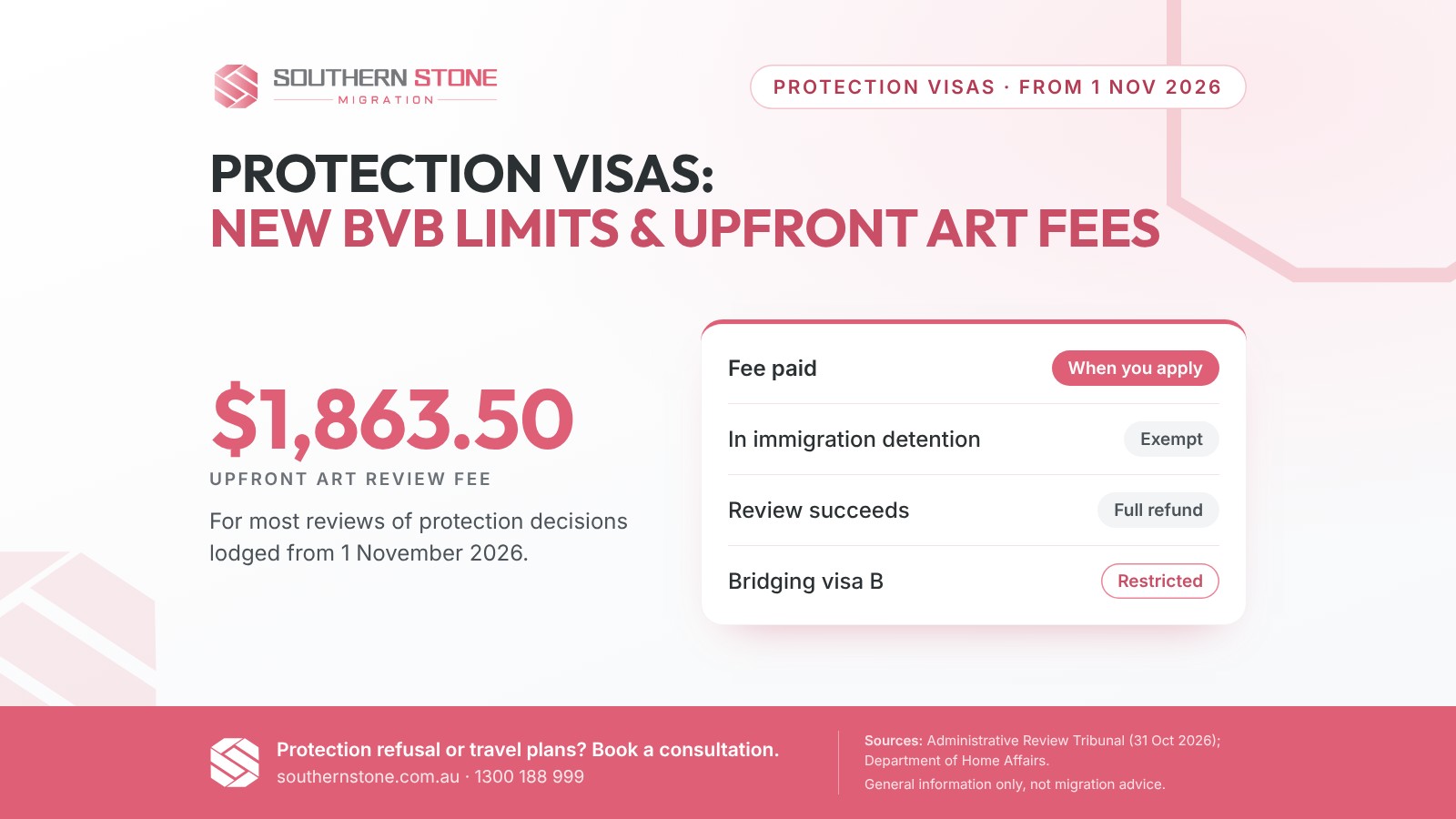
| Change | From 1 November 2026 |
|---|---|
| ART review of a protection decision | Most applicants pay $1,863.50 upfront, when they apply |
| Review lodged before 1 November 2026 | The previous arrangements generally continue |
| Review succeeds | Full refund of the fee |
| Bridging visa B | Not available to many applicants with an unresolved protection matter |
1. Upfront ART fee for protection visa reviews
Until now, people asking the ART to review a protection visa refusal generally did not pay a fee when they applied. A fee was usually payable only if the review was unsuccessful, by invoice after the decision.
From 1 November 2026, most applicants must pay an application fee of $1,863.50 at the time they apply. The fee covers reviews of:
- a decision to refuse or cancel a protection visa, and
- a decision under section 197D of the Migration Act 1958 that a protection finding would no longer be made about a person.
This is a significant change, particularly for applicants experiencing financial hardship.
Which applications does it apply to?
According to the ART, the upfront fee applies to review applications lodged on or after 1 November 2026. Applications lodged before that date generally stay under the previous arrangements: a fee is payable if the review is unsuccessful, and usually not if it succeeds. Where a fee is invoiced, it must be paid within 7 days.
An online application that was started but not submitted before 12:00 am (AEDT) on 1 November 2026 must be restarted, and the upfront fee paid before it is submitted.
Exemptions and refunds
- Exempt: non-citizens in immigration detention, and applicants whose application can be combined with another application for which the fee has already been paid.
- Full refund: if the review is successful, or if the ART finds the application invalid.
- Withdrawing: if you withdraw an application lodged on or after 1 November 2026, a refund is available only in very limited circumstances.
Check your fee obligations before you lodge.
The deadline does not move
The upfront fee does not extend the time limit for applying to the ART. Protection review deadlines are strict, and an application that is not validly made within the time allowed can mean losing the right to review. Your decision letter states the deadline.
2. New Bridging visa B restrictions for protection visa applicants
A Bridging visa B (BVB, subclass 020) ordinarily lets an eligible bridging visa holder leave Australia and return within an approved travel period while their substantive visa application, or another qualifying matter, is unresolved. Our guide to Australian bridging visas explains how each bridging visa works.
From 1 November 2026, applicants may be prevented from making a valid BVB application if they:
- have a Protection (Class XA) visa application that has not been finally determined, or
- are involved in specified judicial review proceedings relating to a protection visa decision.
These restrictions apply to bridging visa applications made on or after 1 November 2026. BVB applications lodged before that date continue to be processed.
What if you already hold a Bridging visa A?
Holding a Bridging visa A (BVA) does not mean you can get a BVB. A BVA generally ceases when its holder leaves Australia, and it does not give permission to return.
For protection visa applicants affected by the new restrictions, travelling overseas and coming back to Australia may now be much harder. Do not travel on the assumption that a BVB will be granted because you hold a BVA.
What to do now
- If your protection visa was refused, note the review deadline in your decision letter and plan for the upfront fee, or check whether an exemption applies.
- If your review was lodged before 1 November 2026, the previous fee arrangements generally apply.
- If you are thinking of travelling overseas while your protection matter is unresolved, get advice before you book. You may not be able to obtain a BVB, or to return.
Frequently asked questions
How much is the ART fee for a protection visa review? $1,863.50, paid when you apply, for most reviews lodged on or after 1 November 2026.
I lodged my review before 1 November 2026. Do I pay upfront? No. Applications lodged before 1 November 2026 generally stay under the previous arrangements, where a fee is usually payable only if the review is unsuccessful.
Who does not have to pay? Non-citizens in immigration detention, and applicants whose application can be combined with another for which the fee has already been paid.
Do I get the fee back if I win? Yes. The fee is refunded in full if the review is successful, or if the ART finds the application invalid.
Does paying the fee give me more time to apply? No. The time limit for applying to the ART is unchanged.
Can I still get a Bridging visa B to travel? Not if your protection visa application has not been finally determined, or you are involved in specified judicial review proceedings, and you apply for the BVB on or after 1 November 2026.
How Southern Stone can help
Protection visa applications and review proceedings involve complex legal requirements, strict deadlines and serious consequences. We assist with visa refusals, ART merits reviews and bridging visa matters. If you have received a protection visa refusal or are unsure about your bridging visa options, book a consultation to discuss your circumstances.
As at 2 November 2026. Sources: Administrative Review Tribunal, "Upfront fees now apply for most reviews of protection decisions" (31 October 2026) and ART fees; Department of Home Affairs; Migration Regulations 1994 as amended from 1 November 2026. General information only, not legal or migration advice.