
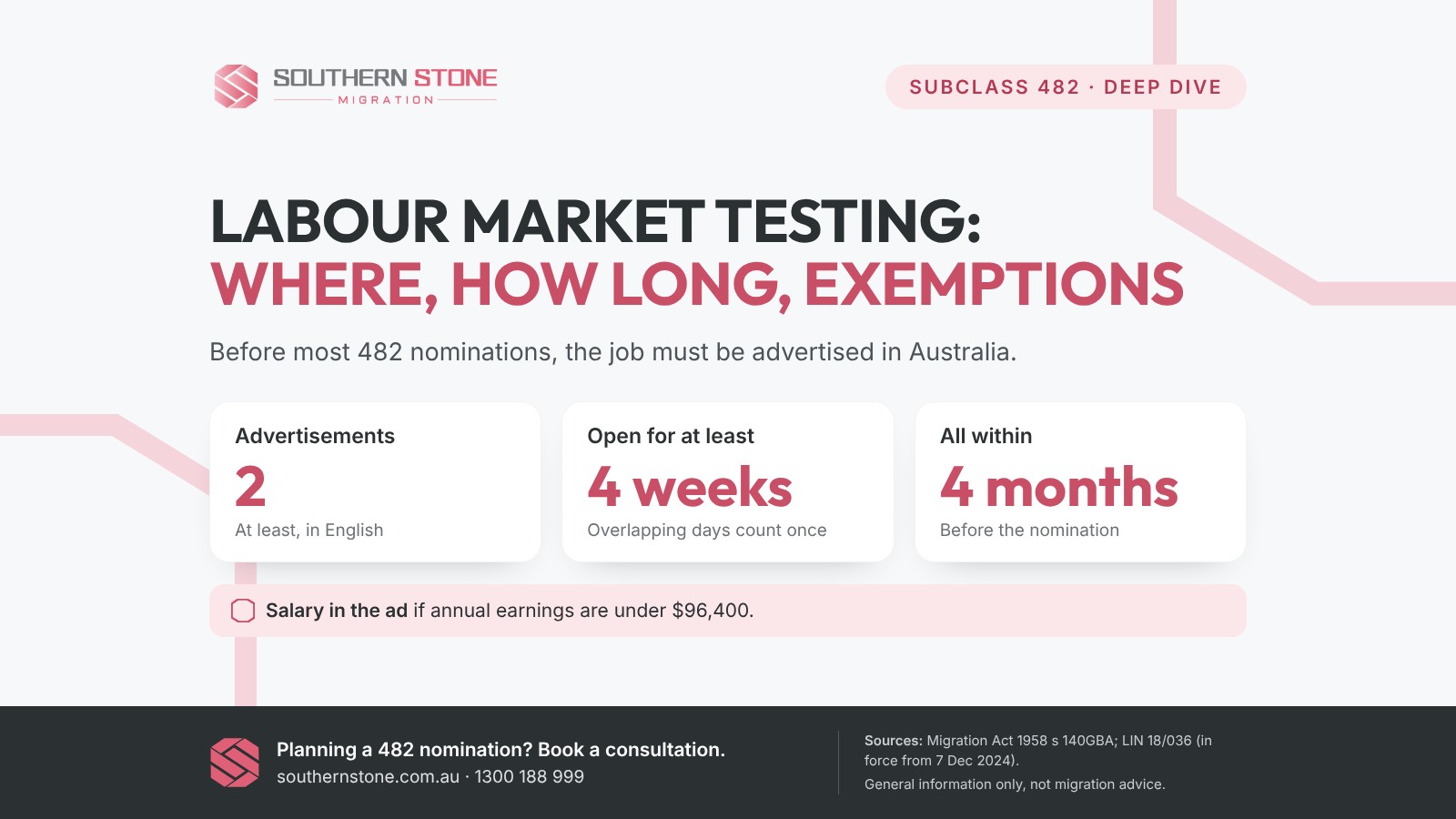
For most 482 nominations, the employer must advertise the job in Australia before nominating an overseas worker. As at 12 November 2026, that means at least two advertisements, in English, each open for applications for at least 4 weeks, all within the 4 months before the nomination is lodged, with copies of the ads lodged with the nomination. The main exceptions come from Australia's international trade agreements, and a small group of positions, including roles paying $250,000 or more, can use a written submission instead.
This deep dive goes through each rule step by step, with the law behind it. For the wider picture of the visa, see our Skills in Demand (482) visa page. If your business is not yet an approved sponsor, start with how a Melbourne business becomes an approved sponsor.
What is labour market testing, and why does it matter?
Labour market testing (LMT) is the employer's evidence that it tried to find a suitably qualified and experienced Australian for the job before looking overseas. It is a condition of the nomination under section 140GBA of the Migration Act 1958. The detailed rules on when, where and how to advertise are in a legislative instrument, LIN 18/036 (the version in force since 7 December 2024).
LMT applies to the Core Skills and Specialist Skills streams of the 482, and to the 494 Employer Sponsored stream. Home Affairs explains the requirements on its labour market testing page.
It matters because the evidence must be right when the nomination is lodged. Advertising that is missing, too old or too short is one of the most common reasons nominations are refused, and it usually cannot be fixed afterwards without advertising again.
Step 1: When must the advertising happen?
All of the labour market testing must happen in the 4 months ending on the day the nomination is lodged (LIN 18/036, section 6). An ad that closed 5 months ago does not count, however good it was.
Plan backwards from the day you expect to lodge:
- Decide the lodgement date for the nomination.
- Count back 4 months. Every ad you rely on must fall inside that window.
- Leave at least 4 weeks inside the window for the ads to stay open, plus time to review applicants.
Redundancies change the start date. If the business made Australian citizens or permanent residents in the nominated occupation redundant or retrenched them in the 4 months before lodgement, the advertising must have taken place after those redundancies, and the nomination must give details of them (Migration Act, section 140GBA(4A)).
Step 2: Where can the job be advertised?
LIN 18/036 requires at least two advertisements, published in Australia, on or in one or more of these (section 8(3)):
- a recruitment website with national reach in Australia
- print media with national reach in Australia
- radio with national reach in Australia
- the business's own website, but only if it is an accredited sponsor
The two ads can be in the same medium (for example, two national recruitment websites) or in different media. Each ad must be commissioned or authorised by the approved sponsor, so a recruitment agency can place them for you (section 8(3A)).
Choose recognised job platforms with real national reach. A post that only appears on a personal social media feed, or on a site that is not a recruitment website, is a risk. If you are unsure whether a platform counts, check before the ads go live, not after.
Step 3: What must each advertisement say?
Each ad must be in English and include (section 8(4)):
- the title of the position, or a description of it
- the skills or experience required
- the name of the approved sponsor, or of the recruitment agency placing the ad
- the salary, if the annual earnings for the position will be less than $96,400 (as at 12 November 2026)
Most refusals at this step come from ads that do not match the nomination. If the ad says "chef" and the nomination is for a cook, or the ad asks for 5 years' experience and the nominee has 2, the Department may not accept that the market was tested for the nominated position. Keep the title, duties, skills and pay consistent with the nomination and the employment contract.
Step 4: How long must the ads stay open?
Each ad must accept applications or expressions of interest for at least 4 weeks from the day it is first published (section 8(5)). Ads can overlap or run back to back to make up the 4 weeks, but overlapping days count only once (sections 8(6) and 8(7)).
In practice, run both ads for a full 4 weeks or more, and keep a record of the dates they were live.
Step 5: What evidence goes with the nomination?
For a nomination that needs advertising, the evidence is a copy of the advertising material for the position (section 9(3)). The Act also asks for information about the business's recruitment attempts, including the cost of the advertising (section 140GBA).
Save each ad as it appeared online or in print, showing the platform, the text and the dates. Keep a simple record of how many people applied, and why those who were interviewed or shortlisted were not suitable. You may not need to send it all, but you will be glad to have it if the Department asks.
Which nominations are exempt from labour market testing?
There is no exemption by occupation. The exemptions that do exist come from two places.
International trade obligations
LMT does not apply where requiring it would be inconsistent with one of Australia's international trade obligations (Migration Act, section 140GBA). The agreements that count are listed in LIN 21/075, and include the WTO General Agreement on Trade in Services and Australia's free trade agreements with countries such as China, Japan, Korea, the United Kingdom, Singapore, Malaysia, Thailand, Chile, Peru, India and Indonesia, plus regional agreements such as AANZFTA, CPTPP, RCEP and PACER Plus. The agreement with the United Arab Emirates was added in 2025.
Whether an agreement helps depends on the worker and the role. Home Affairs gives examples, including:
- the worker is a citizen or national of certain partner countries (for example China, Japan, Malaysia, Thailand or Vietnam), or a citizen, national or permanent resident of others (for example Canada, Chile, Korea, New Zealand, Singapore or the United Kingdom), in a category the agreement covers
- the worker is a current employee of an associated business in certain partner countries, transferring to the Australian business
- the worker is an executive or senior manager of an associated business in a WTO member country, who will run all or a substantial part of the Australian operations
These trade agreement exemptions do not apply to the 494 visa or to labour agreement nominations. The details are set by each agreement, so check the Department's current list for the worker's citizenship and the role before relying on one.
A written submission instead of advertising
For a short list of "select positions", the employer gives a written submission explaining why a suitably qualified and experienced Australian citizen, permanent resident or eligible temporary visa holder is not readily available, instead of advertising (LIN 18/036, sections 4 and 9(2)). As at 12 November 2026, these are:
- roles needing an internationally recognised record of exceptional and outstanding achievement, for example in a profession, sport, academia or research, or as a top-talent chef
- an employee of an established overseas business, nominated by its associated Australian sponsor
- a new nomination for a current 482, 494 or 457 holder, only because their earnings or the sponsor's business structure changed
- roles with annual earnings of $250,000 or more
- most medical practitioner roles (ANZSCO minor group 253, other than general practitioners and "medical practitioners nec") and ambulance officers and paramedics (unit group 4111)
The submission still needs to be specific to the position. A generic statement is unlikely to be enough.
Worked examples
These examples are fictional and simplified. Each business is already an approved sponsor.
Example 1: a café in Box Hill hiring a cook. The owner plans to lodge on 1 March 2027. The 4-month window starts on 1 November 2026. She runs ads on two national job websites from 5 January to 9 February 2027, giving the title "Cook", the skills and experience needed, the business name and the salary of $85,000, because it is under $96,400. Both ads are open for more than 4 weeks and fall inside the window. She saves screenshots with the dates and keeps a note of the applicants. Testing met.
Example 2: an engineering firm in Clayton that delayed lodging. The firm advertised a civil engineer role on two national websites from 1 June to 1 July 2026, then paused the hire. It now wants to lodge on 20 November 2026. The window starts on 20 July 2026, so the June ads fall outside it. The firm must advertise again before it can lodge. If the firm had made a civil engineer redundant in September, the new ads would also have to run after that redundancy, and the nomination would need to give its details.
Example 3: a technology company moving a manager from its Singapore parent. The company plans to nominate an executive from its parent company in Singapore to run the Australian operations, on a 482. This may fall within a trade agreement exemption for an executive of an associated business. The company checks the Department's current list for the role and the agreement, and keeps evidence of the corporate relationship. If the same role were nominated for a 494, the trade agreement exemption would not apply, and the company would need to advertise.
Checklist before you lodge
- The nomination lodgement date is set, and every ad falls within the 4 months before it
- At least two advertisements, published in Australia and in English
- Each ad is on a national recruitment website, national print, national radio or, for accredited sponsors, the business's own website
- Each ad gives the title or description, the skills or experience, and the business or agency name
- The salary is shown if annual earnings are under $96,400
- Applications were open for at least 4 weeks (overlapping days counted once)
- The ads match the nominated position, duties, experience and pay
- Any redundancies in the occupation in the last 4 months are listed, and the ads ran after them
- Copies of every ad, with platform and dates, are ready to attach
- If relying on an exemption or a written submission, the reason is checked against the current rules and documented
Frequently asked questions
Does labour market testing apply to the Specialist Skills stream? Yes, unless an exemption applies. A position with annual earnings of $250,000 or more can use a written submission instead of advertising.
Can we use ads from an earlier recruitment round? Only if they fall within the 4 months before the nomination is lodged and meet all the other rules. Older ads do not count.
Can the worker we want to sponsor place the ads? The ads must be commissioned or authorised by the approved sponsor. The business, or a recruitment agency acting for it, should place them.
How Southern Stone can help
We plan the advertising with you before it goes live, so the timing, platforms and wording match the nomination. We check whether a trade agreement exemption or a written submission applies, prepare the evidence, and lodge the nomination when the window is right. If a nomination has already been refused, see our page on sponsorship and nomination refusal review. We work in English and Mandarin. To talk about sponsoring a worker, book a consultation.
Reviewed by Kathy Liu, Registered Migration Agent (MARN 0958014).