
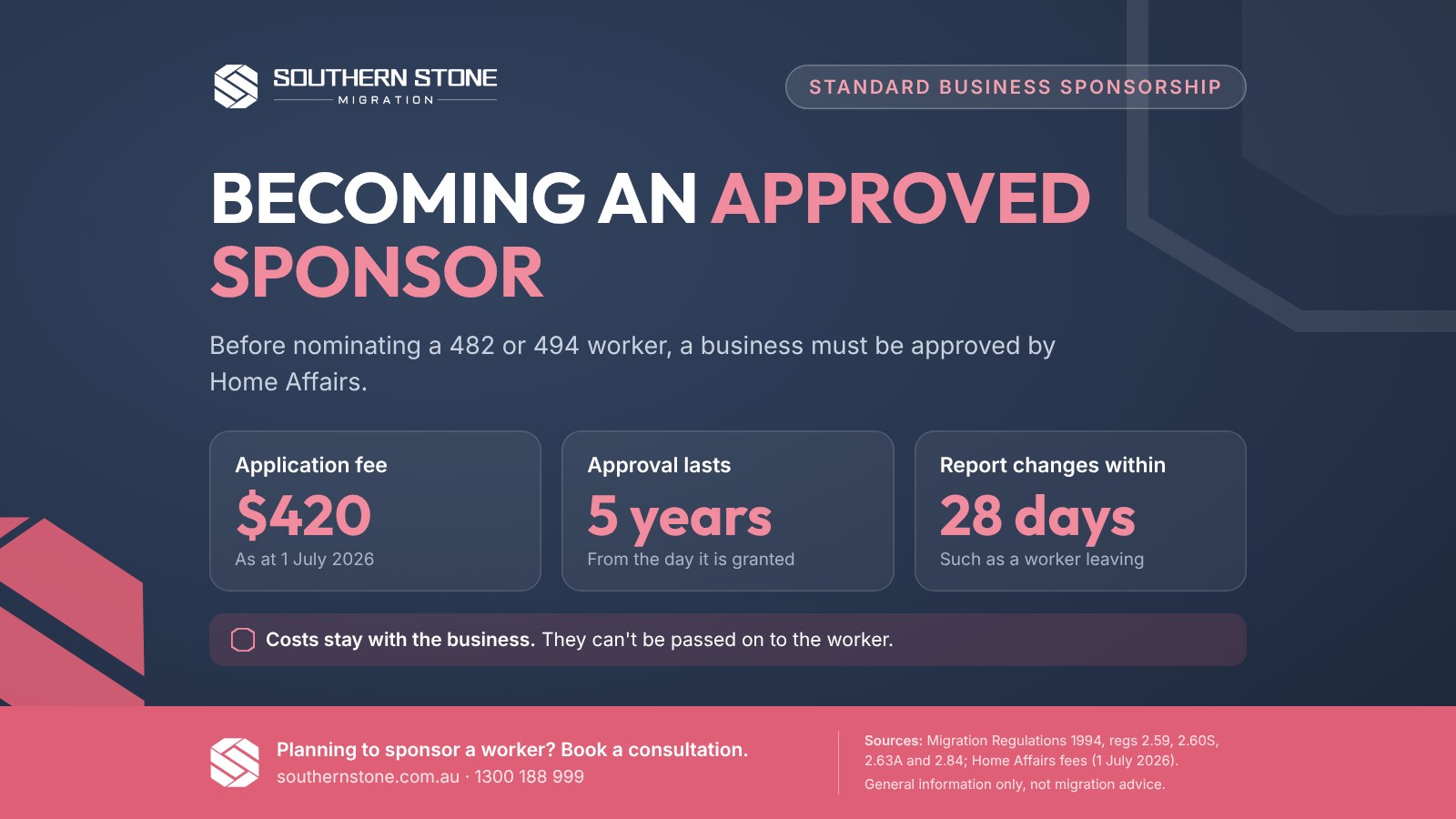
A Melbourne business becomes an approved sponsor by applying online to the Department of Home Affairs for approval as a standard business sponsor. The Department approves the business if it is lawfully operating, makes two written commitments about local hiring and fair recruitment, and has no adverse information that counts against it. Once approved, the business can nominate positions for the Skills in Demand (subclass 482) and Skilled Employer Sponsored Regional (subclass 494) visas for 5 years.
This guide explains each step of Standard Business Sponsorship, what it costs, and the obligations that start once you are approved. If you are still deciding which visa fits the role, start with our overview of employer sponsored visas.
What is an approved sponsor?
Employer sponsorship has three stages, and each one is a separate application:
- Sponsorship: the business is approved as a standard business sponsor.
- Nomination: the business nominates a specific position and the person it wants to fill it.
- Visa: the worker applies for the visa, linked to the approved nomination.
Sponsorship approval is about the business, not the worker or the role. Home Affairs describes a standard business sponsor as an employer it has assessed as suitable to sponsor applicants for the 482 and 494 visas. The same approval also comes before Accredited Sponsor status: a business must be a standard business sponsor before it can become accredited.
The Employer Nomination Scheme (subclass 186) works differently. A 186 has a nomination stage, but no separate sponsorship approval.
Who can become a standard business sponsor?
The rules are in regulation 2.59 of the Migration Regulations 1994. The Department must be satisfied that:
- The business is lawfully operating. It can be a company, a partnership, a trust or a sole trader, as long as the business is real and operating lawfully. Evidence usually includes registration details and records showing the business is actively trading.
- It is committed to local labour. A business operating in Australia must attest in writing that it has a strong record of, or a demonstrated commitment to, employing local labour.
- It recruits fairly. It must declare in writing that it will not engage in discriminatory recruitment practices.
- There is no adverse information, or it is reasonable to disregard any adverse information known about the business or a person associated with it. Past breaches of workplace or immigration law are examples of what the Department looks at.
There is one more condition. A business must not pass on, or try to pass on, the costs of becoming a sponsor to anyone else, including migration agent costs (regulation 2.60S). The same applies to nomination costs and recruitment costs. This is often missed: an agreement that the worker will repay these costs can lead to a refusal.
A business that operates only overseas can also be approved, but only for limited purposes: to establish a business operation in Australia, or to fulfil a contract it has here. Most Melbourne employers apply as Australian businesses.
What does the application involve?
The application is made online through an organisation ImmiAccount, using the Department's form, and the fee must be paid when you apply (regulation 2.61). As at 1 July 2026, the fee for standard business sponsorship is $420. You can check the current employer fees on our fees page.
Before you lodge, have these ready:
- The business's legal name, ABN and structure, and who its directors, partners or owners are
- Evidence that the business is lawfully and actively operating, such as registration documents, recent financial statements, a lease or BAS statements
- The written attestation about employing local labour, and a short explanation of the business's record of hiring Australians
- The written declaration that you will not engage in discriminatory recruitment practices
- A clear answer about any adverse information, such as past workplace or immigration breaches, with an explanation where needed
- Confirmation that no sponsorship, nomination or recruitment costs will be recovered from the worker or anyone else
The Department gives written notice of its decision, with reasons if it refuses (regulation 2.62).
How long does sponsorship approval last?
An approval as a standard business sponsor lasts 5 years from the day it is granted (regulation 2.63A). A business that is already approved can apply again before its approval ends. If the new approval is granted early, it starts when the earlier approval ends, so there is no gap. For an overseas business sponsor, the approval ends after 5 years or when a later approval starts, whichever comes first.
Diarise the expiry date. Nominations can only be made while the business is an approved sponsor.
What happens after the business is approved?
Approval does not let a worker start work. Next, the business nominates the position. As at 1 July 2026, the 482 nomination fee is $330, and the Skilling Australians Fund levy is charged for each year of the visa period nominated: $1,200 a year for businesses with turnover under $10 million, and $1,800 a year for $10 million or more. The levy is paid with the nomination, not with the sponsorship application.
The nomination has its own requirements, including the salary threshold for the stream, the market salary rate and, for most positions, labour market testing. Our guide to 482 Core Skills or Specialist Skills explains how the salary decides the stream. Once the nomination is lodged, the worker lodges their visa application.
What obligations come with sponsorship?
Sponsorship obligations are set out in Division 2.19 of the Migration Regulations. They apply from the time you are approved, and some continue after a sponsored worker leaves. In summary, an approved sponsor must:
- Cooperate with inspectors who check compliance (regulation 2.78)
- Give equivalent terms and conditions: pay and employ the sponsored worker on terms no less favourable than an Australian worker doing the same job (regulation 2.79)
- Pay return travel costs for the worker and their family if asked in writing (regulation 2.80)
- Keep records in the required form, and give them to the Department when asked (regulations 2.82 and 2.83)
- Tell the Department about certain events within 28 days, such as the worker's employment ending or not starting, a change to the worker's duties, a change of address or contact details, or a new director or partner (regulation 2.84)
- Make sure the worker works in the nominated occupation (regulation 2.86)
- Not recover or transfer sponsorship, nomination or recruitment costs to the worker or anyone else (regulation 2.87)
- Not engage in discriminatory recruitment practices (regulation 2.87C)
Breaching an obligation can lead to sanctions, such as a bar on sponsoring or cancellation of the approval, as well as fines or infringement notices. Simple routines for payroll records and notifications prevent most problems. If the Department contacts you about compliance, see our page on sponsor monitoring and sanctions.
What if the sponsorship application is refused?
The refusal letter gives the reasons and explains any review rights. Many sponsorship refusals can be reviewed by the Administrative Review Tribunal (ART), and the time limit to apply is short, so act as soon as the letter arrives. See our page on sponsorship and nomination refusal review. Sometimes a fresh application with better evidence is the quicker path. We can help you work out which applies.
Frequently asked questions
Can a small business or sole trader become a sponsor? Yes. There is no minimum size. The business must be lawfully operating, meet the commitments about local labour and fair recruitment, and be able to meet the sponsorship obligations.
Do we need to be approved before we nominate a worker? Yes. The nomination is for an approved sponsor. Many employers prepare the sponsorship and the nomination together so they can be lodged one after the other.
Can the worker pay the sponsorship fee? No. The business must pay the costs of becoming a sponsor, the nomination and recruitment, including migration agent costs for those stages. Recovering them from the worker breaches the sponsorship rules.
How Southern Stone can help
We check that your business is ready to apply, prepare the sponsorship application and evidence, and lodge the nomination when you are ready to hire. After approval, we explain each obligation in plain language and help you set up record-keeping and notification routines. We work in English and Mandarin. To talk about sponsoring a worker, book a consultation.
Reviewed by Kathy Liu, Registered Migration Agent (MARN 0958014).