
A Skills in Demand visa (subclass 482) is linked to the business that sponsors you, but it does not lock you to that business for the life of the visa. Workers change jobs, businesses restructure and roles end. When a 482 holder moves to a new employer, the usual route is a nomination transfer: the new employer nominates the worker, and in most cases the worker keeps the same visa.
This guide explains how that works for workers and for employers, and where the risks are.
What is a nomination transfer?
"Nomination transfer" is the everyday name for a new nomination lodged by a new employer for a person who already holds a 482 visa. Nothing is moved from the old employer to the new one. The new business must be an approved sponsor (see Standard Business Sponsorship) and lodges its own nomination for the position.
Once the new nomination is approved, the worker's current 482 visa continues, now linked to the new employer. The worker does not need a new visa application if the new position is in the same occupation.
When is a new visa needed?
Condition 8607 requires a 482 holder to work only in the occupation nominated for their most recent 482 visa. So a new visa application is needed when:
- the new employer nominates the worker in a different occupation, or
- the worker's current visa is close to expiry, so a new visa is needed to cover the new position.
In the same occupation, the worker can start with the new employer once the nomination is approved. In a different occupation, they start once the new visa is granted.
Condition 8607: the time limits between employers
Condition 8607 (Migration Regulations 1994, Schedule 8) sets how long a 482 holder can be without work for their sponsor in the nominated occupation:
| Rule | Limit |
|---|---|
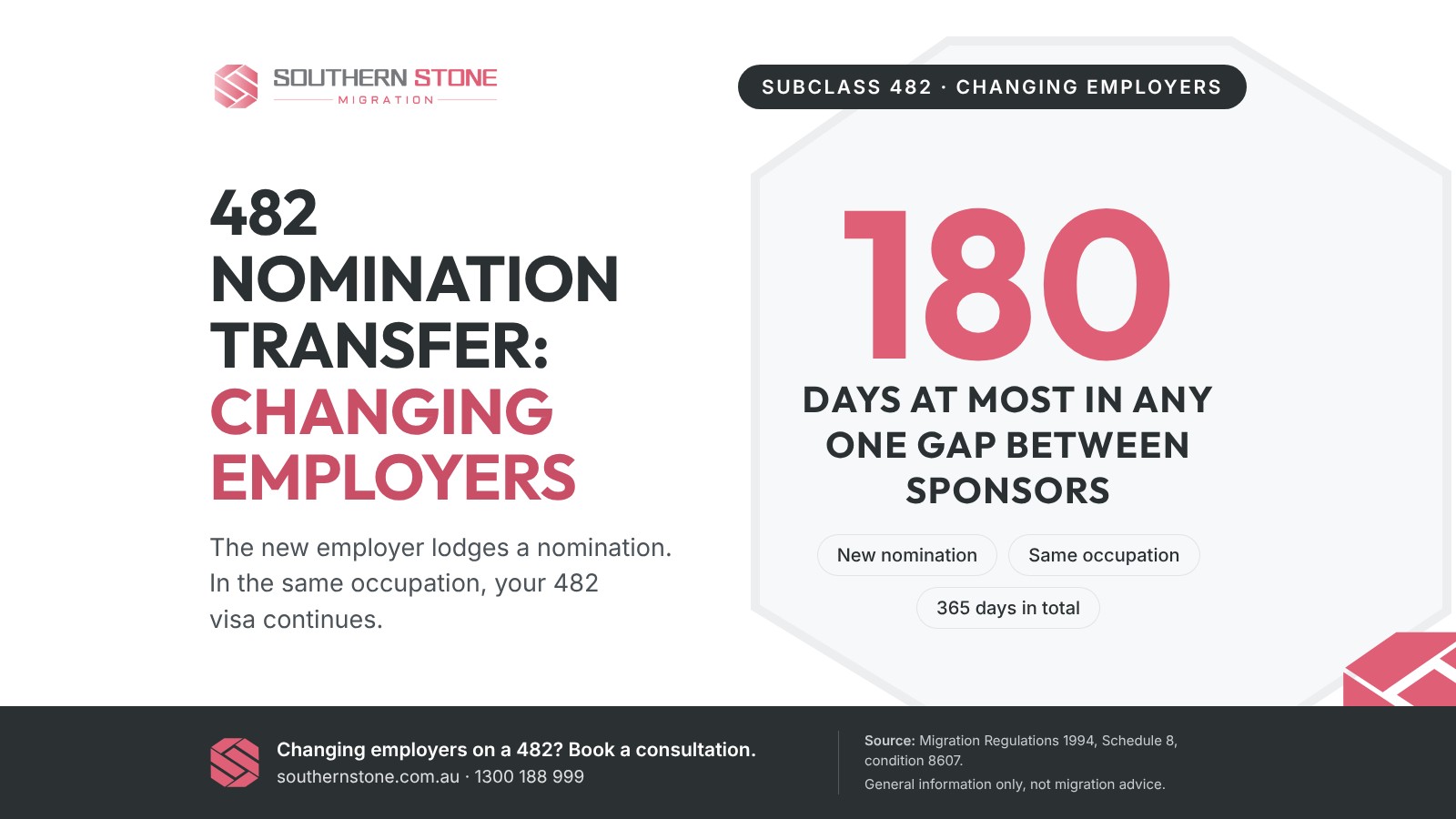
| Any one period | No more than 180 consecutive days |
| Total over the visa period | No more than 365 days |
| Licence or registration | Must be held if mandatory for the occupation where the job is located |
These limits have applied since 1 July 2024. Working outside the condition, or going past the 180-day limit without a new nomination approved or a new visa, is a breach of the visa and can lead to cancellation. Secondary applicants (family members) do not carry this condition.
If you have already changed employers or had gaps during your visa, add up the days before you plan your next move. Earlier gaps count towards the 365-day total.
Steps and timing
- The new employer becomes an approved sponsor, if it is not one already.
- The new employer lodges a nomination for the position, in the worker's occupation where possible.
- If the occupation is different, or the visa is close to expiry, the worker lodges a new 482 visa application.
- The worker starts with the new employer once the nomination is approved (same occupation) or the new visa is granted (different occupation).
- The old employer has its own obligation to tell Home Affairs when the sponsored worker stops working for it. See Sponsor Monitoring and Sanctions.
Processing order is set by Ministerial Directions 121 and 122. See our article on processing priorities for 482 and 186 visas.
What the new employer must show
The new nomination is assessed in its own right, not as a continuation of the old one. The new employer must show that:
- the position is genuine and matches the occupation nominated
- the worker will be paid at least the market salary rate and at least the relevant income threshold. From 1 July 2026 the Core Skills Income Threshold is AUD 79,423 (see 482 and 186 salary thresholds from 1 July 2026)
- labour market testing has been done, unless an exemption applies (see the 482 employer page)
What it costs the new employer
The new employer pays the nomination fee (AUD 330 for a 482 nomination) and the Skilling Australians Fund (SAF) levy for the period nominated (AUD 1,200 or AUD 1,800 a year, depending on business turnover). These charges are the employer's to pay. Current amounts are on our fees page.
Effect on permanent residence (186)
Many 482 holders plan to move to permanent residence through the Employer Nomination Scheme (subclass 186). A change of employer can affect when you become eligible for the Temporary Residence Transition stream. Check this before you move. The rule changes from 29 November 2025 are covered in our Technical Measures 2025 article.
Common mistakes
- Starting work with the new employer before the nomination is approved (or before the new visa is granted, if the occupation changes).
- Letting the 180-day limit run out while waiting for the new employer to become a sponsor or lodge the nomination.
- Nominating a different occupation without realising that a new visa application is needed.
- Forgetting a licence or registration required for the occupation in the new location, for example in another state.
- Not checking the 186 timeline before changing employers.
FAQs
Do I need a new visa to change employers on a 482? Not usually. If the new employer nominates you in the same occupation and your visa is not close to expiry, your current 482 visa continues once the new nomination is approved.
How long can I stay in Australia without a sponsor on a 482? Condition 8607 allows up to 180 consecutive days at a time without working for your sponsor in your nominated occupation, and no more than 365 days in total over the visa period.
Can I start working for the new employer straight away? In the same occupation, you start once the new employer's nomination is approved. In a different occupation, you start once your new visa is granted.
Who pays for the nomination transfer? The new employer pays the nomination fee and the SAF levy. These charges belong to the sponsor.
Does changing employers affect my pathway to the 186? It can. Check your 186 Temporary Residence Transition timeline before you move.
Talk to us
Whether you are a 482 worker with a new job offer or an employer hiring someone who already holds a 482, we check the occupation, salary, visa expiry date and the 8607 days used, and manage the timing so the move happens without a breach. Book a consultation or see our 482 nomination transfers section.
General information only, not migration advice. Sources: Migration Regulations 1994, Schedule 8, condition 8607 (compilation of 2 October 2026); amending regulations F2024L00776 (180 and 365 day limits, from 1 July 2024); Department of Home Affairs, salary requirements and fees.