
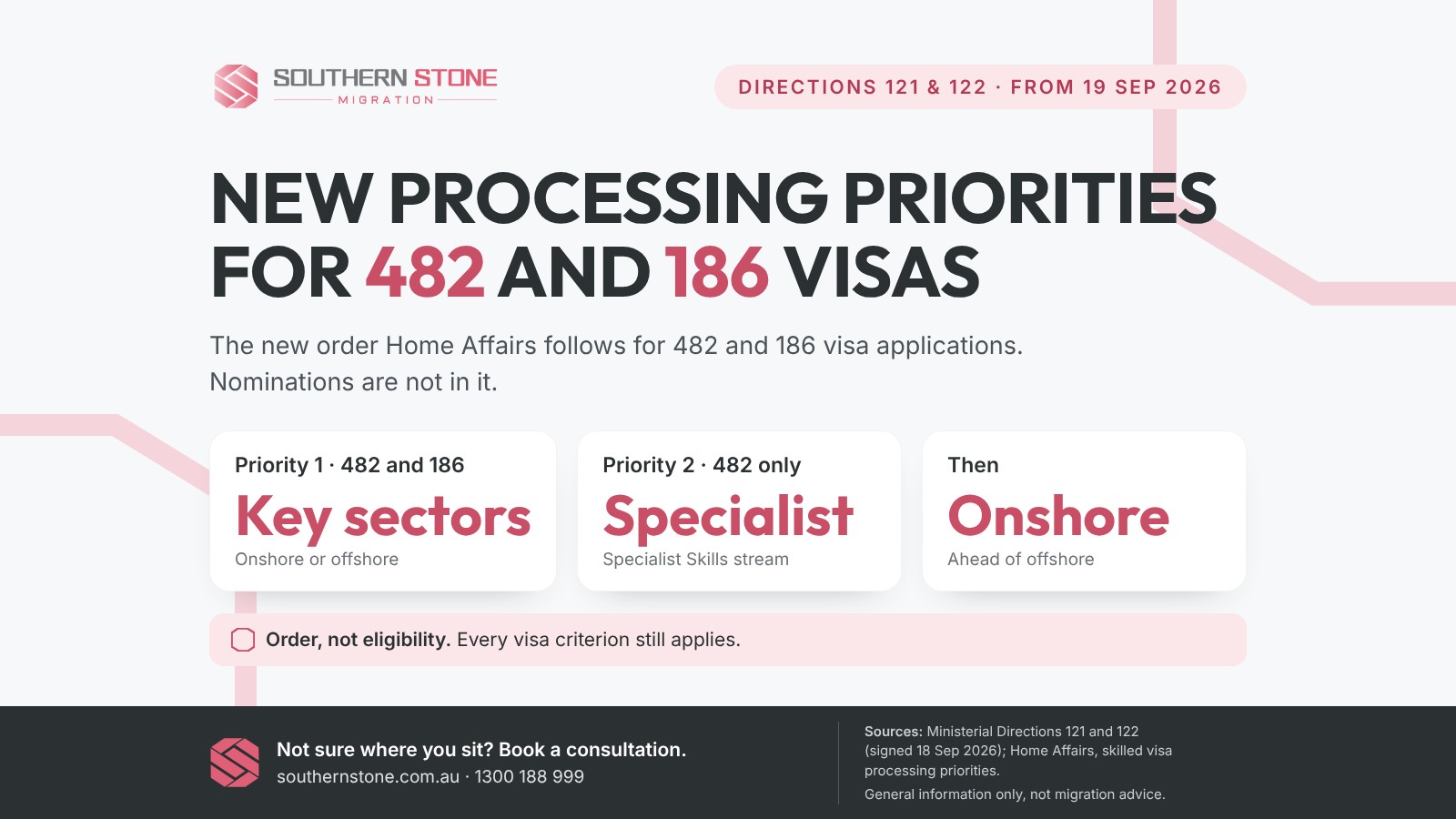
Since 19 September 2026, two Ministerial Directions decide the order in which the Department of Home Affairs works through skilled visa applications. Direction 121 covers the Skills in Demand (subclass 482) visa, and Direction 122 covers permanent and provisional skilled visas, including the Employer Nomination Scheme (subclass 186) visa. Occupations in a small group of priority sectors now go first, wherever the applicant is. After that (and, for the 482, after the Specialist Skills stream), where the applicant was on the day they lodged, and whether family members are included, decides their place.
The Directions change the order, not the rules. Every visa criterion still has to be met, and a higher priority group does not guarantee a grant or a set processing time.
What are Ministerial Directions 121 and 122?
They are directions made by the Minister under section 499 of the Migration Act 1958. Departmental officers who decide visa applications must follow them when deciding which applications to consider first.
- Signed: 18 September 2026. In effect: 19 September 2026.
- Direction 121 covers subclass 482 applications, both the Skills in Demand visa and the old Temporary Skill Shortage (TSS) visa.
- Direction 122 covers subclasses 186, 187, 189, 190, 191, 489, 491, 494, 887 and 888.
- They replace Direction 119, which had applied only since 25 July 2026.
- They apply to applications already waiting, not just new ones. Applications lodged before 19 September 2026 and not yet decided were re-ordered on that day.
- They do not change the occupation lists or any visa requirement.
What is the new processing order?
| Priority | 482 visa (Direction 121) | 186 visa (Direction 122) |
|---|---|---|
| 1 (highest) | Occupations in the priority sectors (construction, healthcare, teaching, agriculture, aquaculture, fishing and resources), or related to law enforcement or defence. Onshore or offshore. | The same priority sectors. Onshore or offshore. |
| 2 | Specialist Skills stream applications, onshore or offshore | Primary applicant in Australia when the application was lodged |
| 3 | Primary applicant in Australia when the application was lodged | Primary applicant outside Australia when lodged, and the application has never been combined with anyone else's |
| 4 | Primary applicant outside Australia when lodged, and the application has never been combined with anyone else's | All other applications |
| 5 (lowest) | All other applications | – |
Family members included in the primary applicant's application take the primary applicant's priority.
What changed from Direction 119?
Direction 119 also put healthcare, teaching and construction near the front, but only for applicants who were in Australia when they lodged. Under Directions 121 and 122:
- Offshore applicants in the priority sectors moved from the back of the queue to the front.
- Agriculture, aquaculture, fishing and resources were added as priority sectors.
- The 482 Specialist Skills stream got its own place, second only to the priority sectors.
- Family members included in an offshore application now affect its place (see below).
- Nominations are no longer in the priority order. Direction 119 had a separate order for employer nominations. Directions 121 and 122 apply only to visa applications.
Regional positions and Accredited Sponsors no longer get priority
Under Direction 105, in effect from 15 December 2023, employer-sponsored applications for positions in regional Australia had the highest priority, and applicants nominated by an Accredited Sponsor were also prioritised. Direction 119 revoked Direction 105 from 25 July 2026 and dropped both groups, and Directions 121 and 122 have not brought them back. A regional location or Accredited Sponsor status no longer moves an application up the order. That includes the Skilled Employer Sponsored Regional (subclass 494) visa, which follows the same order as the 186 under Direction 122.
Which occupations count as a priority sector?
The sector is decided by the nominated occupation, not by the employer's industry. A builder's office manager or accountant is not in the construction sector just because the business is. The Directions define each sector:
- Construction: construction trades workers, construction and mining labourers, construction managers, engineering managers, architects, civil engineers, several building and engineering technician groups, sheetmetal workers, structural steel and welding trades, crane, hoist and lift operators, earthmoving plant operators, and electricians (general and special class).
- Healthcare: health professionals (doctors, nurses, allied health and others), health and welfare support workers, medical scientists, counsellors, psychologists, social workers, medical technicians, and aged or disabled carers, nursing support workers and personal care assistants.
- Teaching: school teachers, child care centre managers, school principals, faculty heads, university lecturers, vocational education teachers and child care workers.
- Agriculture, aquaculture and fishing: there is no occupation list. The test is whether the nominated position is directly involved in primary production or supporting it, for example growing and harvesting crops, raising livestock or seafood, farm supervision, animal health, irrigation, or the slaughter, boning and processing of livestock and seafood.
- Resources: positions that directly support the exploration, extraction and production of minerals, oil and gas or coal, including mine closure and rehabilitation. Mining engineers, geologists, drillers and miners, and some surveyors, metallurgists, fitters and machinists are named, but the position itself has to support the resources sector.
- Law enforcement: police (ANZSCO unit group 4413) nominated or sponsored by the Australian Federal Police or a state or territory police force.
- Defence: occupations supporting AUKUS Pillar I or II, or where the applicant is nominated or sponsored by, or has a letter of support from, the Australian Defence Force or the Department of Defence, with further conditions.
The full lists of ANZSCO groups are in the Directions themselves (links at the end of this article). Choosing an occupation code is a legal question as well as a practical one: the code has to match the real duties of the role. Nominating a priority code that does not fit the job risks a refusal, which costs far more time than the queue.
Does it matter where you are when you lodge?
Yes, outside the priority sectors. The Directions look at whether the primary applicant was in Australia at the time the application was made. That is fixed on the day of lodgement:
- Travelling to Australia after lodging offshore does not move an application up.
- Lodging while you are briefly overseas, for example on holiday, counts as outside Australia.
What about partners and children?
For an offshore primary applicant outside the priority sectors, the 482 and 186 orders separate two groups: applications that have never been combined with another person's application, and all other applications. Including a partner or children puts the application in the lower group, and the words "at any time" suggest that adding someone later can have the same effect.
Separately, a family member who applies on their own after a primary applicant who was in Australia is not covered by the Directions' order at all.
Are nominations prioritised?
No. The Directions apply to visa applications. The employer's nomination is a separate application and is not in the order. A 482 or 186 visa cannot be granted until the nomination is approved, so a top-priority visa application can still wait on the nomination. For employers, a complete, well-prepared nomination lodged early is now the part of the timeline they control most.
Common situations onshore and offshore
These are general examples to show how the order works. Every case depends on its own facts.
Onshore: a chef on a 482 applying for the 186
A chef is not in a priority sector, so a 186 lodged in Australia sits in priority 2 under Direction 122, behind every priority-sector application. The worker should plan around the 482 expiry date. If the 186 is lodged in Australia while the 482 is still in effect, a bridging visa generally keeps them lawful while it is decided, but its conditions need checking, especially before any travel overseas.
Onshore: a registered nurse moving to permanent residence
A registered nurse is in the healthcare sector, so the 186 is in priority 1. The visa will still wait on the nomination, and registration with the Australian Health Practitioner Regulation Agency (AHPRA) has to stay current. The practical risk is now the employer's nomination and the documents, not the queue.
Onshore: lodging the 186 from overseas
A 482 worker in an accounting role lodges the 186 while visiting family overseas. Because they were outside Australia at lodgement, the application drops from priority 2 to priority 3, or to priority 4 if the family is included. Waiting until they are back in Australia would have placed it higher. It is worth confirming where the applicant will be on the day of lodgement.
Onshore: changing employer while the 186 is waiting
If the worker leaves, the 482 can usually move to the new employer through a nomination transfer. The 186 is tied to the employer that nominated the worker, so a change of employer usually means a new 186 nomination, and the worker still has to meet the stream's work-experience requirements. If a new visa application is needed, it takes its place in the queue from its own lodgement date. Talk to us before resigning.
Offshore: a nurse or electrician recruited from overseas
Under Direction 119 these applicants were at the back of the queue. Now a 482 or 186 for an occupation in healthcare or construction is in priority 1, even from offshore. Registration, licensing and any skills assessment often take longer than the visa, so they should start early.
Offshore: a software engineer on a high salary
A role that qualifies for the 482 Specialist Skills stream is in priority 2, whether the worker is onshore or offshore. Trades workers, machinery operators and labourers cannot use that stream at any salary. See Core Skills or Specialist Skills for how the stream is decided.
Offshore: a marketing specialist with a partner and two children
The occupation is not in a priority sector or the Specialist Skills stream. Applying alone would place the 482 in priority 4; including the family places it in priority 5. Applying alone and bringing the family later is possible, but it means a separate application, another fee, and time apart. This is a family decision as much as a processing one, and it needs advice for the particular case.
Offshore: a fitter for a mine, and a fitter for a factory
A fitter whose position directly supports a mining operation can fall within the resources sector and priority 1. The same occupation in a general manufacturing plant does not, and sits with other offshore applications. The position description has to show what the role actually supports.
What should employers do now?
- Lodge the nomination early and complete. It is not prioritised, and the visa cannot be granted without it.
- Check the ANZSCO code against the real duties before deciding whether a role is in a priority sector.
- For agriculture and resources roles, describe the position clearly, because the test is what the position directly supports.
- Confirm where the worker will be on the day the visa is lodged, and plan family members with the worker.
- Track visa expiry dates for staff moving from the 482 to the 186.
- Answer any request for information quickly. A file waiting on documents is not decided, whatever its priority.
What does not change
- The visa criteria, the occupation lists and the salary thresholds.
- Applications where it is readily apparent that the criteria are not met are outside the order, so they can be decided without waiting their turn.
- Applications sent back by the Administrative Review Tribunal for reconsideration are outside the order, and the Tribunal is not bound by these Directions.
- In compelling circumstances, such as community safety, an officer must depart from the order.
Frequently asked questions
When did Ministerial Directions 121 and 122 start? On 19 September 2026. They were signed on 18 September 2026 and replaced Direction 119.
Do they apply to applications lodged before 19 September 2026? Yes. They apply to applications lodged before that date and not yet decided, as well as to new applications.
Does Direction 121 apply to 482 nominations? No. It applies to the visa application. The nomination is not in the priority order.
Will a priority 1 application be decided faster? It is considered sooner, but there is no guaranteed timeframe. The Department publishes current visa processing times, and they can change as applications are re-ordered.
Does moving to Australia after lodging help? No. Location is assessed at the time the application was made.
Do regional positions or Accredited Sponsors still get priority? No. That priority came from Direction 105 and ended when Direction 119 replaced it on 25 July 2026. Directions 121 and 122 do not include it.
How Southern Stone can help
We check the occupation, the nomination and the timing before anything is lodged, and we plan the 482 and 186 together with the employer and the worker. Employers can read about corporate migration advisory; for your own situation, book a consultation.
As at 23 October 2026. Sources: Direction 121 and Direction 122 (signed 18 September 2026); Direction 119 (dated 24 July 2026), which revoked Direction 105; Home Affairs, The Administration of the Immigration and Citizenship Programs (16th edition, June 2026), on Direction 105; Home Affairs, skilled visa processing priorities. Processing priorities can change at short notice.
Reviewed by Kathy Liu, Registered Migration Agent (MARN 0958014).